Every CEO search converges on the same number of true options — 6 candidates, not the hundreds of leaders visible across the industry or the "large number of candidates" that promoters or boards believe are out there. It is the 6 who survive the search funnel and emerge as a true option.
The number that every promoter or board commissioning a CEO search should internalise is 6. It replaces the illusion that senior leadership markets are deep simply because they are visible, or because you know a few well-known names.
In the CEO searches we studied, the true options did not sit at the top of the funnel. They appeared only at the bottom — after technical filters, willingness, assessment, and cultural aspects had done their work. By then, the market had shrunk to less than 1% of its starting size.
The study looked at past CEO mandates across three sectors we worked on in the last six months: medical devices, building materials, and auto components, and reduced each search to its weighted average funnel. The funnel tells the story more clearly than any shortlist can.
At the top, it is wide, almost reassuring: 753 executives who appear relevant on paper across 380+ companies. (Yes — we need to map leadership across this many companies to assure clients of a thorough and comprehensive search.)
But the chart then begins to compress drastically.
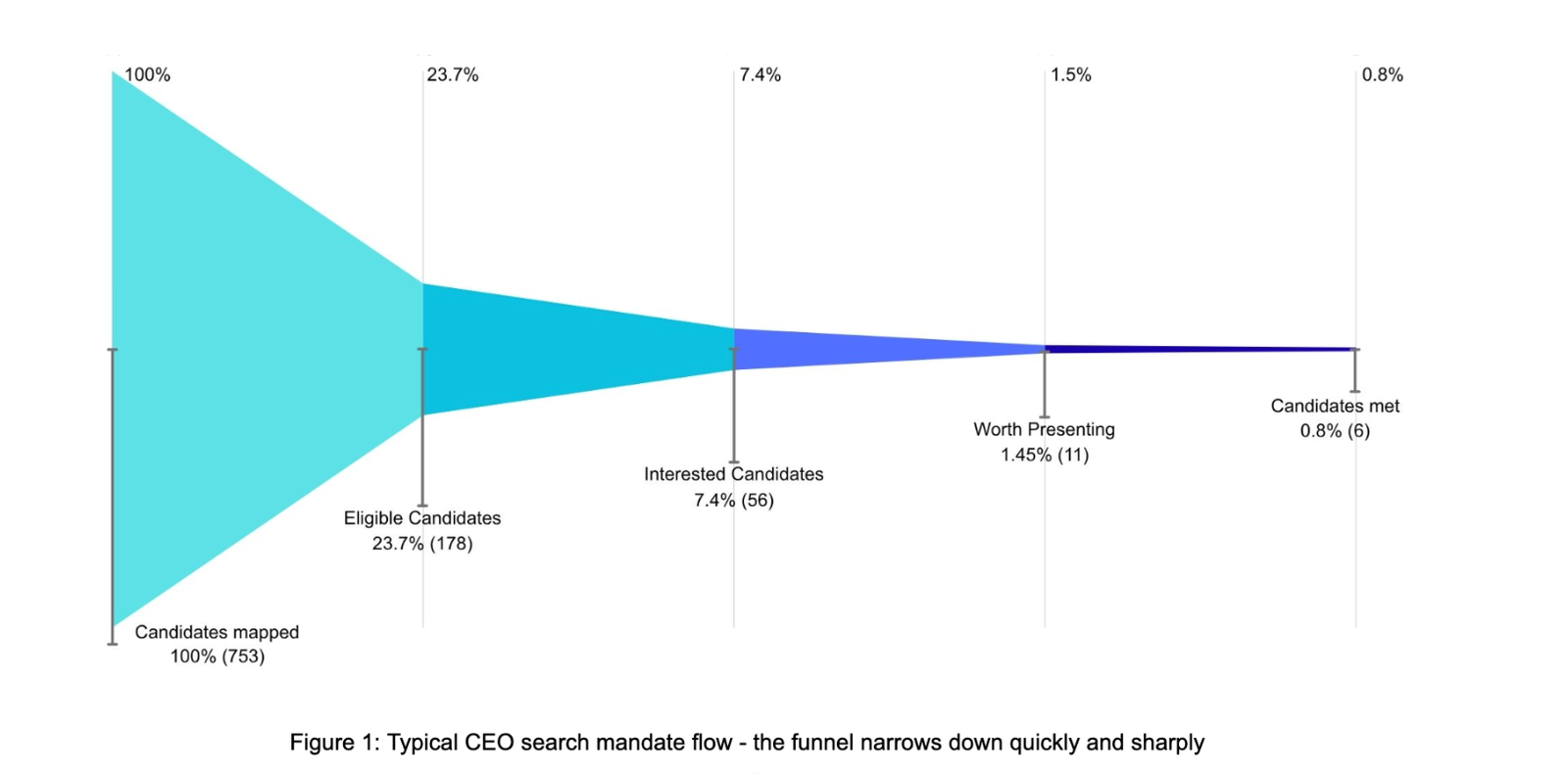
More than three-fourths vanish at the eligibility stage for a variety of reasons — age, compensation, education background, too many moves, recently took up another role. These are all factors apparent from the profile, requiring no candidate engagement yet. The remaining 24% (178 candidates) of the starting pool are the only ones worth approaching.
Of this 24%, another two-thirds disappear when we speak to candidates to test interest and quick fit — leaving just 7.4% (56 candidates) of the mapped universe interested in the role and open to a detailed discussion.
Deep assessment — where we speak to the candidate for 1–2 hours to understand their achievements through the lens of key asks, cultural fit, keenness, movement constraints, and expectations — cuts the field again to just 1.45% of the original pool. What was 750+ to begin with has now come to 11. The abundance has already disappeared from the system.
Eventually, sharpening the focus and helping clients optimise their time investment, we select and share 4–6 candidates for the client to meet — just 0.8% of the original list. The funnel is not a presentation device; it is a record of disappearing assumptions.
For promoters or boards tasked with hiring a CEO, each stage carries a different revelation.
The top of the funnel says the industry is not the market. Even if a sector has hundreds of companies, only some are worth mining in the context of a specific CEO role — companies in the right revenue bucket, with comparable operations and a credible growth record over the last decade. Mapping those companies may produce roughly two relevant leaders per company, but mapped leaders are not candidates.
Technical filters cut down the majority of candidates on experience, compensation, seniority, age, education, location, or other mandate constraints. Interest removes those who are qualified but unavailable. Deep assessment — investing 1–2 hours per candidate to evaluate them in depth — removes those who are keen but not sufficiently relevant. What remains is not a longer list. It is the first honest list.
These 6 candidates are different in every mandate, but the number itself does not seem to move much. One search may produce operators with turnaround experience. Another may produce category builders, manufacturing specialists, distribution scalers, or professional managers suited to a promoter-led transition.
The people change with the unique requirements of each role. Yet across the mandates studied, the pool worth serious consideration stayed broadly in the same band — roughly 9 to 12 candidates worth presenting, and almost always resolving into 6 candidates being recommended to the client. The market looks fluid at the top, but strangely consistent at the bottom.
Those six meetings are the real output of the CEO hiring funnel. They are not six generic senior executives. These are six people who match the unique requirements of one mandate: the company's size, ownership structure, growth ambition, cultural reality, operating complexity, and promoter expectation. Finding them is the work.
The purpose of a CEO search is not to prove that hundreds of leaders exist, or to bring the obvious ones. They do. Its purpose is to show that, for one company at one point in time, only a handful are worth putting across the table.
The sea may be full. But the promoter's or board's real market is six conversations that matter.